
Baccarat Guide helps players understand the game’s rules, betting options, and common wager types in a simple and easy-to-follow format. From card values and scoring rules to dealing procedures and essential terminology, this guide provides the knowledge needed to quickly learn Baccarat and enjoy a more confident gaming experience at Winlah.
Complete Baccarat Guide for New Players
The Baccarat Guide is designed to introduce new players to the fundamental concepts of the game before they begin playing. It explains the dealing process, scoring system, main betting options, and win conditions, making Baccarat easier to understand from the very beginning.
Basic rules and betting options
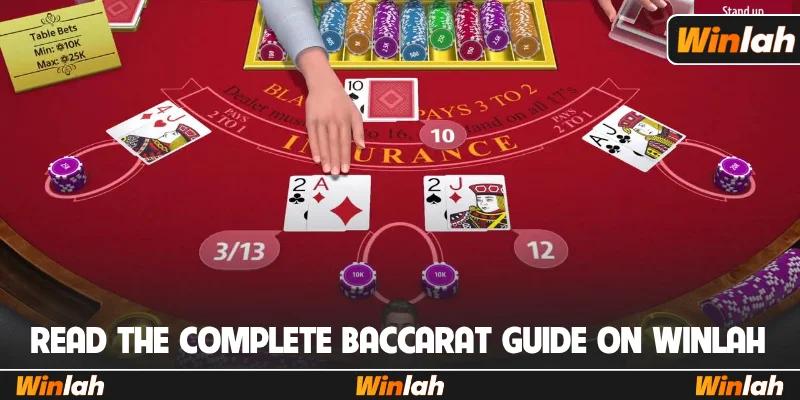
In every Baccarat round, players choose to bet on Player, Banker, or Tie before the dealer begins dealing the cards. Both the Player and Banker hands receive two cards initially, with a possible third card drawn according to fixed Baccarat drawing rules. The hand with a total closest to 9 wins the round, while equal totals result in a Tie.
The primary betting choices are:
- Player: A bet on the Player hand to finish with a higher total than the Banker. The standard payout is typically 1:1.
- Banker: A bet on the Banker hand to finish with a higher total than the Player. The usual payout is 1:1, although a 5% commission is commonly deducted, resulting in an effective payout of 0.95:1.
- Tie: A bet that both Player and Banker finish with the same total. Tie bets generally pay 8:1 or 9:1, depending on the table rules.
Standard Baccarat scoring rules
The Baccarat Guide explains that scoring is straightforward, as only the last digit of the card total is counted. Each card has a fixed value, and the final score is determined by adding the card values together before keeping only the units digit.
- Cards 2–9: Their value equals the number shown on the card.
- 10, Jack, Queen, and King: Each is worth 0 points.
- Ace: Counts as 1.
- Final total: If the sum exceeds 9, only the last digit is used. For example, 7 + 8 = 15, so the final score is 5.
Another example is 9 + 6 = 15, giving a final score of 5. Likewise, 4 + 3 + 8 = 15, so the hand is also scored as 5.
Third card drawing rules in the Baccarat Guide
In Baccarat, the third card is drawn according to fixed rules based on the totals of the Player and Banker after the initial two cards. Players do not choose whether to draw or stand, as the dealer follows the official Baccarat Guide to determine when an additional card should be dealt.

Player’s third-card rules
According to the Baccarat Guide, the Player’s third card rule is applied automatically based on the total of the first two cards. A Natural 8 or 9 for either the Player or Banker ends the round immediately. Otherwise, the dealer determines whether the Player receives a third card using the following rules.
| Situation | Rule |
| Natural | If either the Player or Banker has a total of 8 or 9 after the first two cards, the round ends immediately with no third card drawn. |
| Player total 0–5 | The Player draws a third card. |
| Player total 6–7 | The Player stands and does not receive another card. |
Banker’s third-card rules
Whether the Banker draws a third card depends on both the Banker’s current total and, if applicable, the value of the Player’s third card. The dealer follows the official Baccarat Guide to determine whether the Banker draws or stands.
| Banker Total | Drawing Rule |
| 0–2 | Always draws a third card. |
| 3 | Draws unless the Player’s third card is 8. |
| 4 | Draws if the Player’s third card is 2–7. |
| 5 | Draws if the Player’s third card is 4–7. |
| 6 | Draws if the Player’s third card is 6 or 7. |
| 7 | Always stands and does not draw another card. |
Latest Baccarat Guide payout odds
Baccarat payout odds may vary depending on the casino platform and the specific table rules. However, the most common payout rates are generally applied as follows:
| Bet Type | Typical Payout | Example |
| Player | 1:1 | Bet 100 USD and win 100 USD in profit. |
| Banker | 1:1 (usually with a 5% commission) | Bet 100 USD and receive 95 USD in profit after commission. |
| Tie | 8:1 or 9:1 | Bet 100 USD and win 800 USD or 900 USD in profit. |
| Player Pair | 11:1 | If the Player’s first two cards form a pair, a 100 USD bet returns 1,100 USD in profit. |
| Banker Pair | 11:1 | If the Banker’s first two cards form a pair, a 100 USD bet returns 1,100 USD in profit. |
Tips from the Baccarat Guide
The Baccarat Guide emphasizes understanding the game rules, analyzing previous results, and choosing betting options based on probability rather than guesswork. While no strategy can guarantee consistent wins, having a solid understanding of Baccarat mechanics can help players make more informed decisions throughout the game. Don’t forget that how you access Winlah will completely determine your experience.
Understand the automatic third-card rules
Learning the third-card drawing rules is one of the most important parts of the Baccarat Guide. The Player automatically draws on totals of 0–5 and stands on 6–7, while the Banker’s action depends on both the Banker’s total and the Player’s third card.
For example, a Banker total of 3 draws unless the Player’s third card is an 8, while a Banker total of 6 draws only if the Player’s third card is a 6 or 7. Understanding these situations makes it easier to follow each round without relying solely on the initial totals.
Track past results for potential patterns
The Baccarat scoreboard allows players to review recent outcomes for the Player, Banker, and Tie. You may notice streaks such as consecutive Banker wins, alternating Player and Banker results, or occasional Tie outcomes.
However, previous results only reflect completed rounds and do not predict future outcomes. The Baccarat Guide recommends using game history as a reference for observing table trends rather than treating any streak as a guaranteed indicator of what will happen next.
Observe the frequency of each betting option
Instead of focusing only on the most recent rounds, consider tracking results over a longer period. Recording how often the Player, Banker, and Tie appear can provide a broader perspective on the distribution of outcomes during a particular session.
Even so, every Baccarat round is independent, meaning previous outcomes do not influence future results. The Baccarat Guide suggests using these observations for general reference instead of assuming that earlier patterns will continue.
Conclusion
The Baccarat Guide provides the essential knowledge beginners need to understand Baccarat, including card values, scoring rules, third-card drawing procedures, and the most common betting options. By understanding how the Player, Banker, Tie, and Natural hands work, players can follow each round more confidently and gain a clearer understanding of the game’s mechanics.